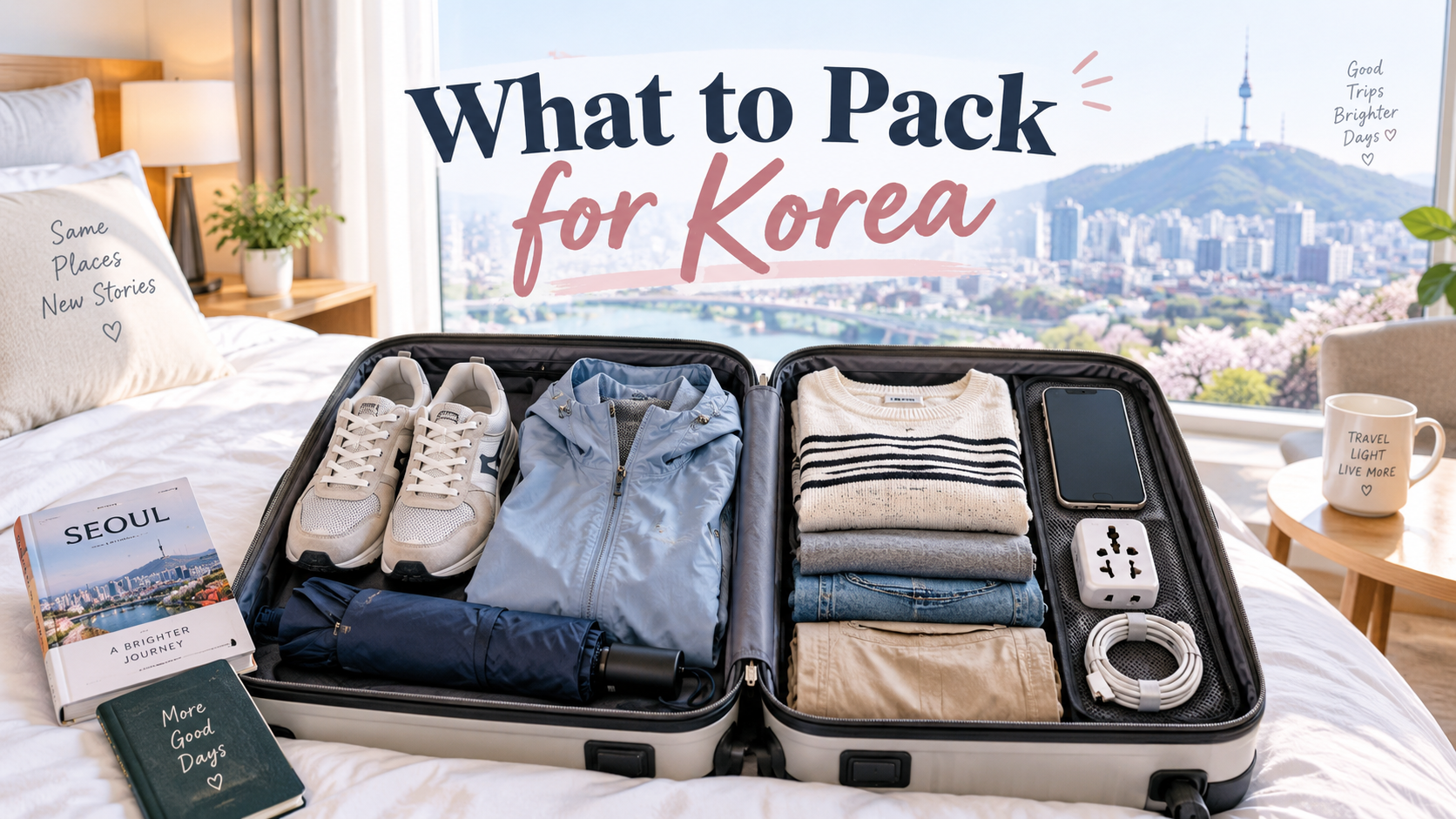
Packing for Korea is easier than many first-time visitors expect.
You do not need to bring everything from home. In cities like Seoul and Busan, convenience stores, Daiso, Olive Young, department stores, and shopping malls make it easy to buy everyday items after you arrive.
The more important question is what is worth bringing with you — and what is just taking up valuable suitcase space.
Quick Korea Packing List

If you want the short version, these are the things I would prioritize:
- Comfortable walking shoes
- Clothes you can easily layer
- A light jacket, windbreaker, or weather-resistant outer layer in spring and fall
- Warm outerwear for winter
- A power adapter if your plugs are different from Korea’s
- Phone, charging cable, and portable battery
- Any medication you specifically need
- A small day bag
- A compact umbrella if rain is likely
- Enough empty suitcase space for shopping
You can buy most basic toiletries and travel items in Korea, so there is usually no reason to pack your suitcase completely full.
1. Comfortable Walking Shoes Are More Important Than Extra Clothes

If there is one thing I would not compromise on, it is shoes.
Travelers often walk much more in Seoul than they expect. Even when you use the subway, there can be long transfers, stairs, underground shopping areas, palace grounds, and plenty of walking between nearby attractions.
Bring one pair of shoes that you already know you can comfortably wear all day. A second fashionable pair is fine if you have room, but you probably do not need several pairs.
Local Tip: Korea is very convenient for public transportation, but “taking the subway” does not mean you will avoid walking. Good shoes will probably help you more than almost any other item in your suitcase.
2. Pack Clothes You Can Layer
Korea has four distinct seasons, but the most practical packing strategy is not simply “summer clothes” or “winter clothes.” Layers are especially useful because the temperature can feel very different between morning, afternoon, and evening.
Spring
Spring can feel warm in the afternoon but surprisingly cool in the morning or after sunset, especially earlier in the season.
A T-shirt or light knit, combined with a jacket or windbreaker that is easy to remove, is usually more practical than carrying one heavy coat.
Summer
Korean summers are hot and humid, and the rainy season usually overlaps with part of summer.
Bring lightweight, breathable clothes and shoes that can handle some rain. A compact umbrella or light rain jacket can also be useful, although umbrellas are extremely easy to buy after you arrive.
Fall
Fall is one of the easiest seasons to pack for, but temperatures can still change quite a bit throughout the day.
Many people in Korean cities prefer relatively light outerwear during spring and fall — for example, a windbreaker, light shell, cardigan, or jacket that can easily be taken off and carried.
A wind-resistant or water-resistant outer layer is particularly convenient because you can use it for cool mornings, windy days, and light rain without bringing a bulky coat.
Winter
Winter is different. December through February can become very cold, and temperatures can fall below freezing.
For the coldest part of winter, a proper warm puffer or winter coat is the safer choice.
That said, lightweight padded jackets are also very common and useful in Korea. They work well during milder winter weather or as an extra layer underneath a coat or jacket.
Local Tip: When sightseeing in a city like Seoul, you constantly move between cold streets and heated subways, cafés, restaurants, and shopping malls. Clothing that is easy to layer, remove, and put back on can be more comfortable than wearing one extremely bulky outfit all day.

3. Bring the Right Power Adapter

Korea uses 220V electricity at 60Hz with two round-hole outlets.
If your devices use a different plug shape, bring a suitable travel adapter. Also check the voltage information printed on your charger or device before using it in Korea.
Most modern phone and laptop chargers support a wide voltage range, but an adapter changes the plug shape — it does not automatically convert voltage.
You can also buy travel adapters in Korea, including at airports and many retail stores, but bringing one means you can charge your phone immediately after checking in.
4. Do Not Forget Your Phone Setup
Your phone will probably be one of your most important travel tools in Korea.
Before leaving home, make sure you have a charging cable, portable battery if you use one, and a plan for mobile data.
An eSIM can be especially convenient because you can arrange your data before arrival instead of looking for a SIM card after landing.
It is also worth installing the essential Korea travel apps before your trip so you are not trying to set everything up while standing at the airport.
5. Bring Important Medication — But Check the Rules First
If you rely on a specific prescription medicine, bring enough for your trip rather than assuming you will be able to buy the same product in Korea.
However, some medicines containing controlled substances can require approval before entering Korea.
If you take prescription medication, especially medication that may contain a controlled or psychoactive substance, check the latest Korean government rules before departure.
Keeping medicine in its original packaging and carrying supporting prescription information is also a sensible precaution.
6. Toiletries: Bring Your Favorites, Buy the Basics in Korea
You do not need to pack a large supply of everyday toiletries.
Basic shampoo, body wash, toothpaste, skincare products, tissues, razors, and many other travel necessities are easy to find in Korean cities.
Stores such as Olive Young and Daiso are everywhere in popular tourist areas, and convenience stores can solve many small travel emergencies.
However, bring products that are difficult to replace for you personally — for example, a specific skincare product, prescription item, or brand that you know works well for you.

7. Things You Can Easily Buy in Korea
You can usually save suitcase space by buying inexpensive everyday items after arrival.
- Umbrellas
- Basic toiletries
- Skincare products
- Tissues and wet wipes
- Simple charging cables
- Heat packs in winter
- Snacks and drinks
- Basic travel accessories
This is especially useful if you are staying mainly in Seoul, Busan, or another large city.
You are not traveling somewhere without shops, so there is little benefit in packing for every possible emergency.
8. What NOT to Bring to Korea

Too Much Cash
You do not need to arrive with a large amount of Korean won. Cards are widely used in Korea, although having some cash is still useful for certain situations.
Too Many Clothes and Shoes
If you plan your outfits around a few layers that work together, you can travel much lighter.
You will also probably want some suitcase space for shopping — especially if places like Myeongdong, Hongdae, or Seongsu are on your itinerary.
Food, Plants, and Other Regulated Items Without Checking First
Do not assume that every food item you can put in your suitcase can automatically enter Korea.
Animals and animal products, meat, plants, fruits, vegetables, agricultural products, and some foods can be subject to declaration, quarantine, or other restrictions.
If you are unsure about something you want to bring, check Korea Customs and the relevant Korean government guidance before departure.
9. What I Would Pack for One Week in Korea
For a typical one-week city trip, I would keep the list relatively simple.
- One comfortable pair of walking shoes
- Several tops that can be mixed and matched
- Two or three bottoms
- One practical outer layer appropriate for the season
- Underwear and socks
- Phone and charging equipment
- Travel adapter if needed
- Important medication
- A small day bag
- A few personal toiletries
In spring or fall, I would personally prioritize a light windbreaker or weather-resistant jacket over a bulky outer layer.
In winter, I would add proper cold-weather protection, but I would still use layers so that I can remove something when entering a heated subway, café, or shopping mall.
10. Leave Some Space in Your Suitcase
This may be the easiest packing mistake to avoid.
Many visitors end up buying skincare, clothes, snacks, souvenirs, or other items in Korea. If your suitcase is already completely full when you arrive, packing for the return flight becomes much more annoying.
Bring what is difficult to replace, pack comfortable clothing for the season, and leave some room for everything else.
FAQ
Do I need a power adapter for Korea?
Korea uses 220V electricity at 60Hz with two round-hole outlets. If your plug is different, you will need an appropriate adapter. Check whether your device also supports 220V.
What shoes should I bring to Korea?
Bring shoes you already know are comfortable for long days of walking. Seoul trips often involve more walking than first-time visitors expect, even when using public transportation.
Should I bring an umbrella?
You can, especially if rain is forecast, but inexpensive umbrellas are very easy to buy in Korea. There is no need to pack a large one just in case.
Do I need to bring cash to Korea?
You do not need to carry a large amount of cash. Cards are widely accepted, although a small amount of Korean won can still be useful.
Can I bring prescription medication to Korea?
Many travelers bring personal medication, but some medicines containing controlled substances require prior approval. Check the latest rules for your specific medication before traveling.
What should I wear in Korea in spring or fall?
Layers work well. A shirt or light knit combined with a windbreaker, light shell, or jacket is practical because mornings and evenings can feel much cooler than the middle of the day.
Leave a Reply