Apple Pay, T-money & Foreign Cards Explained
As a Korean local, I know how people here normally pay for buses and subways.
But I do not automatically know how transit payment works in every other country.
When I started looking at this question from a foreign traveler’s point of view, I realized why it can be confusing.
In some cities, you can simply tap your bank card or phone at the gate. In others, a local transportation card is still part of the system. So I looked at examples travelers may already know, such as Japan’s Suica and London’s Oyster, and compared them with how Korea works.
Personally, I actually like physical transportation cards when I travel.
I often keep them after a trip instead of treating them as disposable. Sometimes I can use them again on a future visit, depending on that system’s validity rules. And even when I do not, I think a transportation card is part of the local travel experience — almost like a small souvenir from that city.
That is also how I think about T-money in Korea.
But before your first subway or bus ride, there is one more practical question:
Can you simply tap the credit card or phone you already have, or should you get a Korean transportation card?

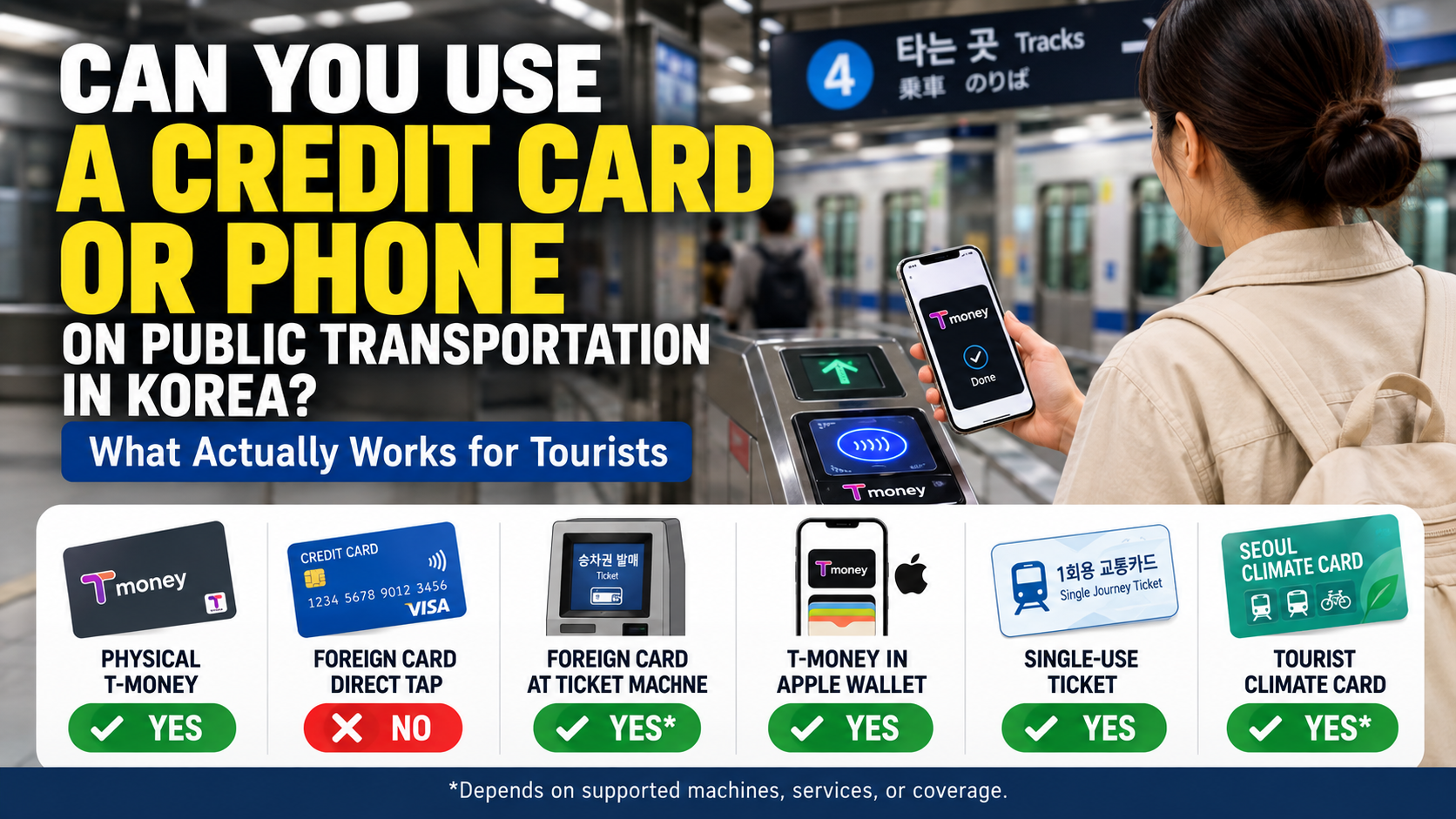
Quick Answer: What Can You Actually Use?
| Payment Method | Use at Subway / Bus Reader? |
|---|---|
| Physical T-money | ✅ Yes |
| Foreign Visa / Mastercard | ❌ Not normally as a direct gate tap |
| T-money in Apple Wallet | ✅ Yes, on compatible devices |
| Normal Visa / Mastercard in Apple Pay | ❌ Not as a transit card |
| Foreign card at a supported ticket machine | ✅ For some tickets and tourist passes |
| Tourist Climate Card | ✅ Within its supported Seoul network |
Local Dad Tip: If a friend were visiting Korea for the first time and wanted the easiest option, I would still tell them to start with a physical T-money card.
1. Can You Tap a Foreign Credit Card Directly?

For normal subway and city-bus travel, you should not arrive in Korea expecting to tap a foreign-issued Visa or Mastercard directly at the gate or bus reader.
That is different from systems such as London, where contactless bank cards are widely used directly for public transportation.
In Korea, most travelers still use a dedicated transportation card such as T-money, a supported mobile transportation card, or an appropriate ticket or pass.
But Your Foreign Card Is Not Useless for Transportation
This is an important distinction.
Using a foreign card directly at the subway gate and using a foreign card to buy a ticket at a machine are not the same thing.
Some newer subway ticket machines in Seoul can accept international credit and debit cards for supported products, including certain single-journey tickets and short-term tourist transportation passes.
So the practical rule is:
- Foreign card directly at the gate: Do not rely on it.
- Foreign card at a supported ticket machine: It may work for certain tickets or passes.
Korea is also moving toward more open-loop transit payment technology using global card networks. But until direct bank-card tapping is actually available across the routes you plan to use, I would not plan a trip around it.
Local Tip: New payment technology is interesting, but when I travel I prefer to rely on what already works everywhere rather than what may be coming soon.
2. Can You Use an iPhone or Apple Watch?

Yes — if you use T-money in Apple Wallet.
This is where one important distinction causes a lot of confusion.
Your normal Visa or Mastercard stored in Apple Pay is not the same thing as a T-money transportation card stored in Apple Wallet.
Think of it like this:
- Foreign Visa or Mastercard in Apple Pay → generally not a subway or bus transportation card
- T-money in Apple Wallet → yes, it can be used on supported T-money public transportation
With Express Mode enabled, you can tap a compatible iPhone or Apple Watch on the transportation reader without unlocking the device each time.
That is extremely convenient once everything is set up.
The Important Part for Foreign Visitors
The easiest way to use T-money on an iPhone and the easiest way to fund that T-money are two different questions.
If you add and recharge T-money directly inside Apple Wallet, the current official requirements include a supported Korean-issued payment card.
Tmoney also provides other top-up options through the Mobile Tmoney app, but those payment methods and account requirements may not be practical for every short-term international visitor.
So if you are visiting Korea with only overseas-issued cards, I would not assume that mobile T-money will automatically be easier than a physical card.
Local Dad Tip: If your iPhone setup already works, mobile T-money is very convenient. But I would see it as an upgrade, not something every first-time visitor needs to solve immediately after landing.
3. What About Android Phones?
Android users also have mobile transportation-card options in Korea.
However, device compatibility, NFC support, apps, payment methods, account requirements, and the exact transportation product can vary.
That is why I would keep the advice simple for a short trip.
If you already know that your Android phone and mobile transit setup are compatible, using your phone can be convenient.
But if you are standing at the airport trying to figure everything out for the first time, I would not make mobile transit setup your first travel task.
A physical T-money card removes most of those compatibility questions.
4. Do You Still Need Cash for a Physical T-money Card?
A physical T-money card is simple to use, but its purchase and recharge rules are separate from the question of whether a foreign bank card works at a subway gate.
Cash in Korean won is still one of the most reliable ways to recharge a standard physical T-money card at convenience stores and many station facilities.
I would therefore keep a small amount of Korean won available rather than assuming every T-money top-up point will accept your overseas credit card.
I do not want to repeat the full T-money guide here.
If you want to know where to buy a card, how to recharge it, how transfers work, and how refunds work, see my complete T-money guide for tourists.
5. What About the Tourist Climate Card?

If you will stay mainly in Seoul and use public transportation frequently, the short-term Climate Card can be another option.
Tourist passes are available for:
- 1 day
- 2 days
- 3 days
- 5 days
- 7 days
The main difference is simple:
- T-money: Pay as you go for each trip.
- Tourist Climate Card: Unlimited rides within the supported network during the selected period.
Some supported Seoul subway ticket machines can accept international credit or debit cards when purchasing or recharging eligible short-term Climate Card products.
But the Climate Card does not cover every transportation route in Korea.
That matters if you are leaving Seoul, using airport transportation, or taking routes outside its supported area.
Local Tip: Do not choose a transit pass only because it offers unlimited rides. Check where you are actually going first.
6. What Would I Recommend for a First Trip?
If a friend were visiting Korea for the first time, I would still tell them to get a physical T-money card first.
Not because mobile payment is bad.
A physical card is simply easy.
You buy it, add money, tap it, and use it without worrying much about phone compatibility, wallet settings, or whether a specific overseas payment card can fund your mobile transportation balance.
And personally, I do not think a local transportation card has to become useless the moment your vacation ends.
When I travel abroad, I often keep my transit cards.
Japan’s Suica is one example. A standard Suica can remain usable for years, although JR East says it becomes invalid after ten years without use. London’s Visitor Oyster works differently: its pay-as-you-go credit does not expire, so it can be kept for a future visit.
I like that.
There is a practical reason — I may use the card again when I return — but there is also a small collecting aspect for me.
Transportation systems are part of what makes a city feel different from another city. A Suica, Oyster, or T-money card feels like a small piece of that local system.
So if you buy a T-money card during your Korea trip, you do not necessarily have to think of it as something to throw away before your flight home.
You might use it again on your next Korea trip.

My Simple Decision Guide
If you want the simplest first-trip option:
Get a physical T-money card.
If you already have a compatible iPhone and know your T-money setup works:
Using T-money in Apple Wallet can be very convenient.
If you only have a foreign bank card:
Do not assume you can tap it directly at the gate. Use a transportation card or buy a supported ticket or pass.
If you will ride public transportation heavily and stay mainly within Seoul:
Check whether the Tourist Climate Card fits your routes.
For me, that is easier than trying to find one payment method that does absolutely everything.
FAQ
Can I tap a foreign Visa or Mastercard directly on the Seoul subway?
Generally, you should not rely on a foreign-issued Visa or Mastercard as a direct subway-gate transportation card. Korea is developing broader open-loop payment options, but a dedicated transportation card or supported ticket remains the safer plan for travelers.
Can I use Apple Pay on Korean public transportation?
You can use a compatible iPhone or Apple Watch when T-money is added to Apple Wallet. This is different from simply tapping a normal Visa or Mastercard stored in Apple Pay.
Can tourists buy subway tickets with a foreign credit card?
Some newer supported ticket machines in Seoul accept international credit or debit cards for certain tickets and tourist transportation products. This does not mean the same card can necessarily be tapped directly at the subway gate.
Is a physical T-money card still worth getting?
For most first-time visitors, I think so. It is simple, widely useful, and avoids many phone and payment-compatibility questions.
Should I get T-money or a Tourist Climate Card?
T-money is a flexible pay-as-you-go option for travelers moving around Korea. A short-term Climate Card can be attractive if you will use public transportation frequently and remain mainly within its supported Seoul coverage. Check your actual itinerary before choosing.
Can I keep my T-money card for another Korea trip?
Yes. If you prefer, you can keep the physical card instead of disposing of it at the end of your trip. Check the latest T-money validity and balance rules before relying on an older card during a future visit.
Leave a Reply