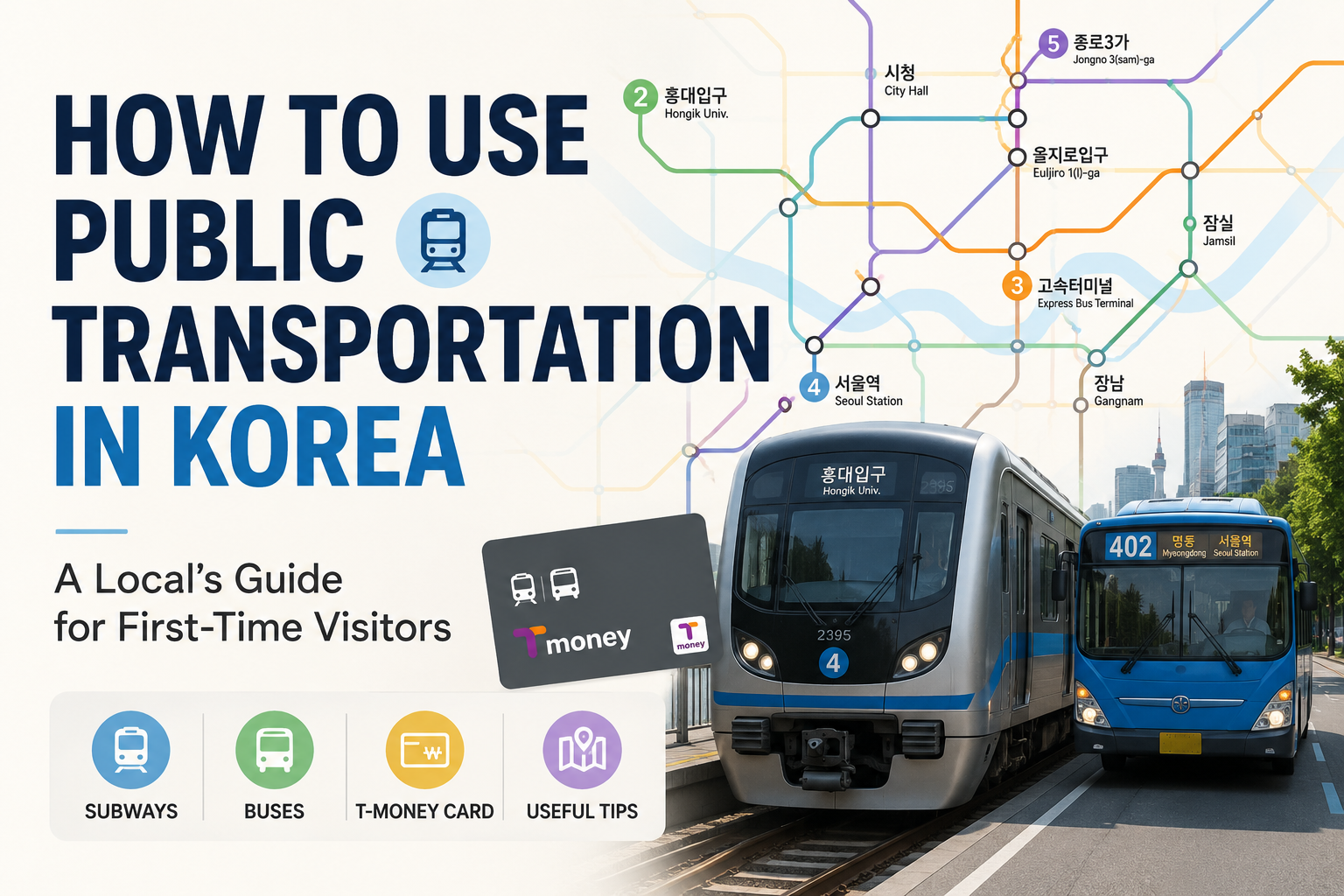
When visitors ask me about getting around Korea, I usually give them a simple answer:
In Seoul, I use the subway first.
I live in Suwon and visit Seoul regularly with my family. Even as a local, I do not usually try to drive everywhere or take taxis across the city. Seoul has an extremely dense public transportation network, and for most major attractions, shopping areas, business districts, and neighborhoods, the subway is usually the easiest place to start.
That does not mean I never use buses, taxis, or trains. I do — but I use each of them for a specific reason.
This guide is not meant to explain every ticket, fare, and button in detail. Instead, I want to show you how I actually choose between the subway, bus, taxi, and train when traveling around Seoul and nearby areas.
Quick Answer: How I Usually Get Around
- Subway: My first choice for most trips inside Seoul
- Bus: Useful when the subway route requires unnecessary transfers or a long detour
- Taxi: Helpful with tired children, heavy luggage, late-night travel, or awkward local connections
- Train: One of my favorite ways to travel between Seoul, Suwon, and other cities
- Hangang Bus: A newer Seoul transport option I have not tried yet, but one I want to experience
1. In Seoul, I Usually Choose the Subway First
Seoul has one of the most extensive subway networks in Korea.
The core Seoul subway system includes Lines 1 through 9, the Ui–Sinseol Line, and the Sillim Line. It also connects with several metropolitan rail lines that extend into the wider Seoul Capital Area.
For a traveler, the exact number of lines is less important than this:
Most places you are likely to visit in Seoul can be reached comfortably by subway.
Major tourist areas such as Myeongdong, Hongdae, Gyeongbokgung, Gangnam, Jamsil, Dongdaemun, and Yeouido are all connected to the rail network.
That is why I usually take the subway when I go into Seoul with my family.
It is predictable, you do not have to worry about road traffic, and the arrival time is much easier to estimate than when traveling by car.

Local Tip
When I travel in Seoul with my kids, I usually prefer the subway over the bus. If a bus is crowded and there are no seats, standing can be uncomfortable for young children, especially when the vehicle turns or stops suddenly.
Another reason I find the subway convenient for family travel is accessibility.
Many stations have escalators or elevators somewhere in the station, although the easiest accessible entrance is not always the one closest to you.
If you are traveling with a stroller, luggage, or young children, I recommend checking the station layout and exit information before you arrive.
For a detailed beginner guide, see:
How to Use the Seoul Subway: A Beginner’s Guide for Tourists →
2. When Do I Use the Bus?
I do not use buses as often as the subway when traveling around Seoul.
For me, buses are most useful when the subway route does not make geographical sense.
Sometimes two places look close on a map, but traveling between them by subway requires two transfers and a large detour. In that situation, a direct bus can be much faster.
That is when I compare the options in Naver Map.
If the subway is simple, I usually take the subway.
If the subway requires several transfers but one bus can take me there directly, I may take the bus instead.

Local Tip
If you use a city bus, remember to tap your transportation card when you get on and again when you get off. This is important for fares and transfers.
For families with small children, I would also consider how crowded the bus is likely to be.
If we cannot get seats, I usually prefer the subway unless the bus route saves a significant amount of time.
3. Get a Transportation Card Before You Worry About the Details
For most short-term visitors who plan to use buses and subways, a transportation card such as T-money is one of the simplest ways to get started.
You can use the same card across many subway and bus systems, which means you do not need to buy a separate ticket for every ride.

I would not try to explain every T-money rule in this guide because we already have a full guide for that.
If you want to know where to buy one, how to recharge it, how refunds work, and how to use it correctly, see:
How to Use a T-money Card in Korea: A Complete Guide for Tourists →
If you are wondering whether you can simply tap a foreign credit card or phone at a subway gate, see:
Can You Use a Credit Card or Phone on Public Transportation in Korea? →
4. I Do Not Use Taxis Much Inside Central Seoul
Taxis in Korea are convenient, but inside Seoul I personally do not use them very often.
The reason is traffic.
Seoul is a huge, densely populated city, and there are a lot of cars on the road. A route that looks short on a map can take much longer during busy hours.
When traffic is heavy, you can end up sitting in a taxi while the meter continues running.
For longer trips across central Seoul, I usually prefer the subway because the travel time is more predictable.
That does not mean taxis are a bad option.
I am much more likely to take one when:
- My children are tired
- We have several bags or suitcases
- The destination is far from a subway station
- The route requires too many transfers
- We are traveling late at night
And outside the busiest parts of Seoul, the calculation can change.
When I travel around parts of Gyeonggi Province with my family, I am more willing to take a taxi for a short local trip, especially if the kids are tired or we have luggage. Traffic can still exist, of course, but it is often less intense than crossing central Seoul.
For taxi apps, I now recommend looking at both Uber and k.ride rather than assuming you need a Korean-only app.
Best Apps for Traveling in Korea →
5. Trains Are Underrated for Traveling Around the Seoul Area
I live in Suwon, and trains are one of the transportation options I use quite often when going to Seoul.
Depending on the service and station, rail can be much faster and more comfortable than driving through traffic. Some trips between Suwon and central Seoul can take roughly 20–30 minutes by faster rail services, although the exact time depends on the train and destination.
This is especially useful if you are staying outside central Seoul or visiting places in Gyeonggi Province that have convenient rail connections.
And trains become even more useful when you travel farther.
Korea has KTX, SRT, ITX, Mugunghwa, and other rail services connecting Seoul with cities around the country.
I use train travel in real life with my family too.
On weekends, I sometimes take my kids to places such as Daegu, Gyeongju, or Busan — sometimes to watch baseball, sometimes for a food trip, and sometimes just to see the sea.
That is one reason I think visitors should not automatically assume that traveling outside Seoul is difficult.
With the right train, another city can feel much closer than it looks on the map.
6. Use Naver Map to Decide, Not Just to Navigate
I do not use Naver Map only after I have chosen a route.
I use it to decide which type of transportation makes sense in the first place.
For example, I might compare:
- A subway route with two transfers
- A direct bus
- A taxi travel time
- The walking distance from the station

That comparison is often more useful than automatically choosing the fastest-looking option.
If you are traveling with children, luggage, or older family members, the route with the fewest transfers can sometimes be better than the route that saves five minutes.
For detailed instructions, see:
How to Use Naver Map in Korea →
7. A New Option I Want to Try: Hangang Bus
There is one Seoul transportation option I have not tried yet: the Hangang Bus.
It is a river-based public transportation service operating along the Han River, connecting the western and eastern parts of Seoul with several riverside stops.

I cannot give you a personal review yet because I have not ridden it.
But I genuinely want to try it the next time I spend a day in Seoul.
The Hangang cuts across Seoul from east to west, and I like the idea that the journey itself can become part of the travel experience.
The subway may still be faster for many routes, but watching the city from the river sounds very different from sitting underground between stations.
Local Perspective
I would not recommend the Hangang Bus as your default transportation choice without comparing the route and timetable first. But as a visitor, I think combining transportation with a view of Seoul could make it worth trying at least once.
So What Should You Use?
If this were my first trip to Seoul, I would keep the decision simple.
- Start with the subway for most sightseeing.
- Use a bus when it avoids an awkward subway detour.
- Use a taxi when comfort matters more than cost or when the subway route is inconvenient.
- Use trains when traveling between Seoul, nearby cities, or other regions of Korea.
- Use Naver Map to compare the options before you leave.
You do not need to master Korea’s entire transportation system before your trip.
Learn the subway first, get a transportation card, and then add buses, taxis, or trains when they actually make your journey easier.
Leave a Reply