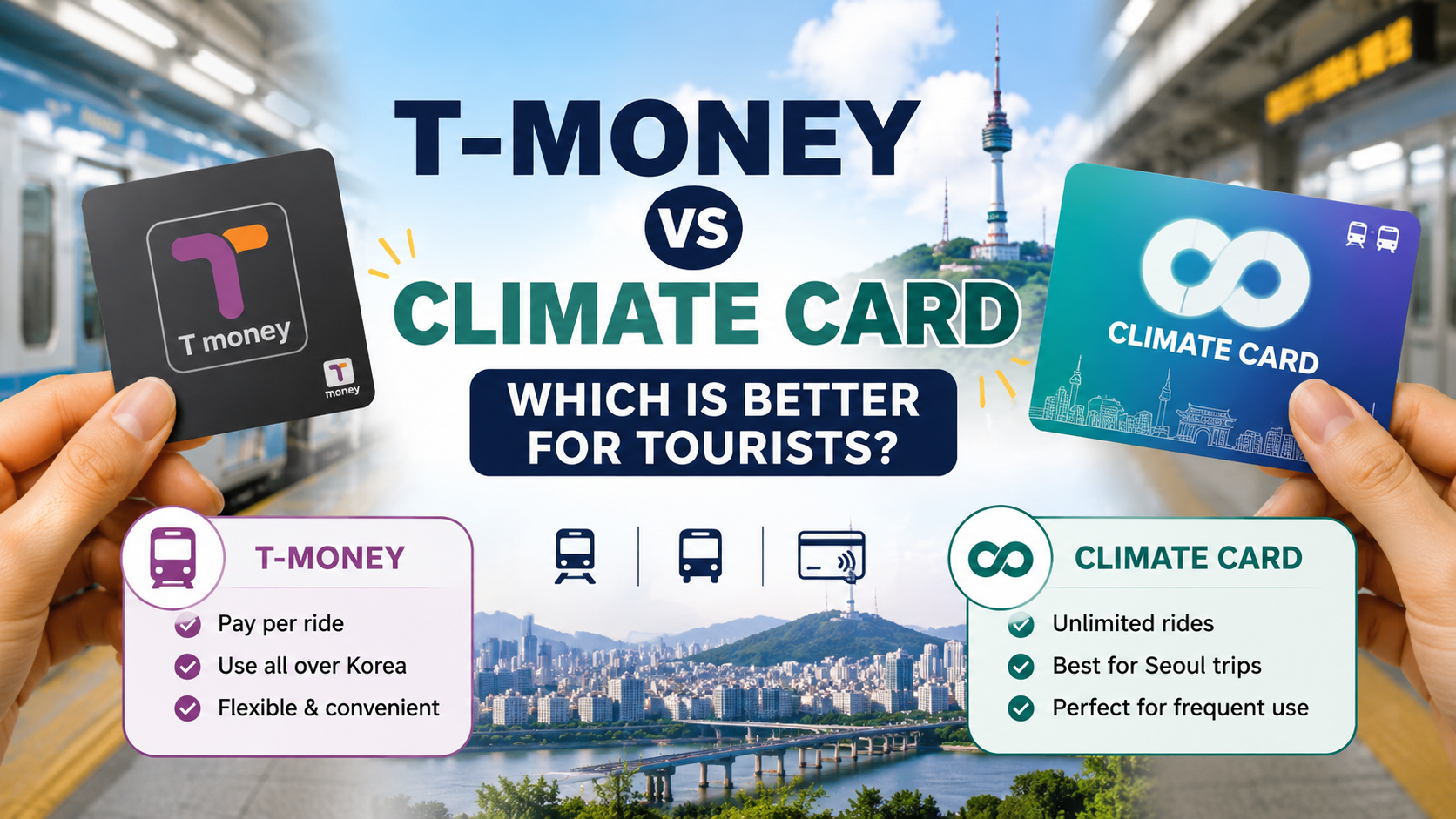
If you are visiting Seoul, one of the first transportation questions you may have is simple:
Should you buy a T-Money card or a Climate Card?
Both cards can make getting around Seoul much easier, but they work in very different ways.
T-Money is a rechargeable transportation card that you pay for each time you ride.
The Climate Card offers unlimited rides within its covered area for a fixed period.
For most first-time visitors, the better choice depends on three things:
How many days you will stay in Seoul
How often you plan to use public transportation
Whether you will travel outside Seoul
In this guide, I’ll explain the differences and help you decide which card makes more sense for your trip.

Quick Summary
Here is the simplest way to decide.
Choose T-Money if:
You will travel outside Seoul
You only expect to take a few subway or bus rides each day
You want one transportation card that works throughout much of Korea
You prefer paying only for the transportation you actually use
Choose the Climate Card if:
You will spend most of your trip inside Seoul
You expect to use the subway and buses frequently
You want unlimited rides without thinking about each fare
You are staying in Seoul for 1, 2, 3, 5, or 7 days
For many first-time tourists spending several busy sightseeing days entirely in Seoul, the Climate Card can be very convenient.
But T-Money is still the more flexible option.
What Is a T-Money Card?
T-Money is Korea’s most widely used rechargeable transportation card.
You load money onto the card and the fare is deducted every time you use public transportation.
Simply tap the card when entering and leaving the subway or when getting on and off a bus.

T-Money can be used on public transportation in many parts of Korea, not just Seoul.
This makes it particularly useful if your trip includes destinations such as Busan, Gyeongju, or other Korean cities.
It is also accepted at many participating convenience stores and other locations displaying the T-Money logo.
Where Can Tourists Buy T-Money?
Regular T-Money cards are widely available at convenience stores such as:
- CU
- GS25
- 7-Eleven
You can also find them at transportation-related locations in Seoul.
A basic T-Money card typically costs around KRW 3,000 to 5,000 before adding transportation credit.
You then add money separately and use the balance as you travel.
The Biggest Advantage of T-Money
Flexibility.
You are not buying an unlimited travel period.
You simply pay whenever you use transportation.
If you take only two or three rides during the day, you are not paying for transportation you did not use.
And if you travel outside Seoul, you can continue using T-Money on many public transportation systems around Korea.
What Is the Climate Card?
The Climate Card is Seoul’s unlimited public transportation pass.
Instead of paying separately for each subway or bus ride, you purchase a pass for a specific period and can take covered transportation repeatedly during that period.
For short-term visitors, the available passes are:
1-day pass: KRW 5,000
2-day pass: KRW 8,000
3-day pass: KRW 10,000
5-day pass: KRW 15,000
7-day pass: KRW 20,000
A physical Climate Card itself costs an additional KRW 3,000.

The short-term tourist passes are especially useful for visitors who plan to spend several busy days sightseeing around Seoul.
One Important Thing About the Climate Card
The Climate Card does not cover every transportation route around the Seoul metropolitan area.
It mainly covers participating Seoul subway lines and Seoul-licensed buses.
Some routes outside the service area are excluded.
The Sinbundang Line and certain transportation outside Seoul are examples of services that may not be covered.
This is one of the biggest differences between the Climate Card and T-Money.
T-Money is generally much easier if your itinerary includes places outside central Seoul.
T-Money vs Climate Card: The Main Difference
The easiest way to understand the difference is this:
T-Money = pay per ride
Climate Card = unlimited rides for a fixed period

With T-Money, your transportation spending increases every time you take another ride.
With the Climate Card, your transportation cost stays the same during the valid period, as long as you stay within the supported network.
That means the Climate Card becomes more attractive when you use public transportation frequently.
Which One Is Cheaper?
There is no single answer because it depends on how much you travel.
As a rough example, the standard adult subway base fare when using a transportation card in Seoul is currently KRW 1,550.
This means a tourist taking several subway or bus rides every day can quickly spend several thousand won on transportation.
For example, imagine you take:
Subway to Gyeongbokgung
Subway to Myeongdong
Bus or subway to another attraction
Subway to Hongdae
Subway back to your hotel
A sightseeing day like this can involve many separate rides.
If your itinerary is packed with attractions, a short-term Climate Card may make sense.
On the other hand, if you spend most of the day walking around one neighborhood and only use the subway two or three times, T-Money may be cheaper.
When I Would Choose T-Money
I would choose T-Money in several situations.
You Are Traveling Beyond Seoul
If your Korea trip includes Seoul and other cities such as Busan or Gyeongju, T-Money is usually the more convenient basic transportation card.
You will not need to change your transportation setup every time you move to another city.
You Do Not Use Public Transportation Very Often
Some travelers move constantly.
Others choose one neighborhood and spend several hours walking.
If your schedule looks like:
Morning in Gyeongbokgung
Walk to Bukchon
Walk to Insadong
Dinner nearby
you may only use transportation a few times that day.
In that situation, unlimited transportation may not provide much value.
You Want Maximum Flexibility
With T-Money, you do not need to calculate whether your trip fits a certain pass period.
Load money, tap the card, and use it when needed.
That simplicity is why I still consider T-Money one of the safest choices for first-time visitors.
When I Would Choose the Climate Card
The Climate Card becomes more attractive when your trip is concentrated in Seoul.
You Have a Busy Seoul Itinerary
Imagine your day includes:
Gyeongbokgung Palace
Myeongdong
N Seoul Tower
Hongdae
Han River
That can mean several subway and bus rides.
If you plan days like this repeatedly, unlimited transportation is convenient.

You Do Not Want to Think About Your Remaining Balance
With T-Money, you need enough balance on the card.
With the Climate Card, once the pass is active, you can keep using covered transportation during the valid period.
For travelers who want simplicity, this can be surprisingly convenient.
You Are Staying Almost Entirely Inside Seoul
This is probably the most important point.
The Climate Card is designed around Seoul transportation.
If almost all of your sightseeing happens inside Seoul, it fits the trip very well.
Can Tourists Buy the Climate Card?
Yes.
Short-term Climate Card passes are available for tourists.
Physical cards can be purchased at designated subway facilities, ticket vending machines, and participating convenience stores near certain subway stations.
Tourists can also purchase or recharge short-term Climate Card passes using internationally issued credit or debit cards at supported vending machines.
However, availability and supported payment methods can vary by location, so I recommend checking the latest official information when you arrive.
Does the Climate Card Work from Incheon Airport?
This is where tourists need to be careful.
The Climate Card is primarily designed for transportation within Seoul and does not simply replace every airport transportation option.
Depending on the Airport Railroad station and direction of travel, coverage can be limited.
For your trip from Incheon Airport to Seoul, I recommend checking your airport transportation separately rather than assuming the Climate Card will cover everything.
If you are arriving in Korea for the first time, read my guide:
How to Get from Incheon Airport to Seoul: AREX, Bus or Taxi?
Do You Need Both Cards?
Not necessarily.
Most tourists can choose one as their main transportation card.
However, there is nothing wrong with using both.
For example:
Climate Card for several intensive sightseeing days in Seoul
T-Money for airport transportation or travel outside the Climate Card service area
This can actually be a practical setup for travelers spending a week or more in Korea.
What I Recommend for First-Time Visitors
If this is your first Korea trip, I would use this simple rule.
3 to 7 Days Almost Entirely in Seoul
Consider the Climate Card.
Especially if you plan to visit several attractions every day and use public transportation frequently.
Seoul Plus Busan, Gyeongju, or Other Cities
Choose T-Money as your main transportation card.
It is much more flexible for a multi-city Korea trip.
Relaxed Seoul Trip With Lots of Walking
T-Money may be enough.
There is little reason to buy unlimited transportation if you will only take a few rides per day.
Very Busy Seoul Sightseeing Trip
Climate Card becomes much more attractive.
Unlimited rides mean you do not need to worry about whether taking an extra subway or bus ride is worth it.
A Local Tip
Do not choose your transportation card based only on the number of days you are staying.
Look at your actual itinerary.
This makes a bigger difference than most travelers realize.
For example, Gyeongbokgung Palace, Bukchon Hanok Village, Insadong, and Gwanghwamun are relatively close to each other.
You may spend half a day exploring this part of Seoul mostly on foot.
Another day, you might travel between Gangnam, Seongsu, Myeongdong, and Hongdae and use public transportation constantly.
So before buying a pass, look at where your attractions are located.
Naver Map is particularly useful for planning these routes.

T-Money vs Climate Card: My Final Recommendation
For most tourists:
T-Money is best for flexibility.
Climate Card is best for unlimited transportation inside Seoul.
If your trip includes several cities, choose T-Money.
If you are staying entirely in Seoul and expect to use the subway or bus many times every day, consider the Climate Card.
Neither option is universally better.
The best card is simply the one that matches your itinerary.
And if you are still unsure, T-Money is the easier default choice because you can use it throughout more of your Korea trip.
FAQ
Is T-Money or Climate Card better for tourists?
T-Money is usually better for travelers visiting several Korean cities or using transportation only occasionally.
The Climate Card may be better for tourists staying mainly in Seoul and taking many subway or bus rides every day.
How much does the Climate Card cost for tourists?
Short-term passes currently cost KRW 5,000 for 1 day, KRW 8,000 for 2 days, KRW 10,000 for 3 days, KRW 15,000 for 5 days, and KRW 20,000 for 7 days.
A physical card costs an additional KRW 3,000.
Can foreigners buy a Climate Card?
Yes. Short-term passes are available to international visitors.
Can I use T-Money outside Seoul?
Yes. T-Money can be used on many public transportation systems throughout Korea, which is one of its biggest advantages over the Climate Card.
Can I use the Climate Card in Busan?
No. The Climate Card is a Seoul transportation product and should not be treated as a nationwide transportation card.
Can I buy the Climate Card with an international credit card?
Internationally issued credit and debit cards are accepted for purchasing and recharging short-term Climate Card passes at supported new transportation card vending machines in Seoul. This is different from tapping a normal foreign credit card or phone directly at subway gates or bus readers; for that distinction, see Can You Use a Credit Card or Phone on Public Transportation in Korea?
Related Guides
How to Use Public Transportation in Korea: A Local’s Guide for First-Time Visitors
How to Get from Incheon Airport to Seoul: AREX, Bus or Taxi?
Best Apps for Traveling in Korea: Naver Map, Papago, Taxi Apps & More
Leave a Reply