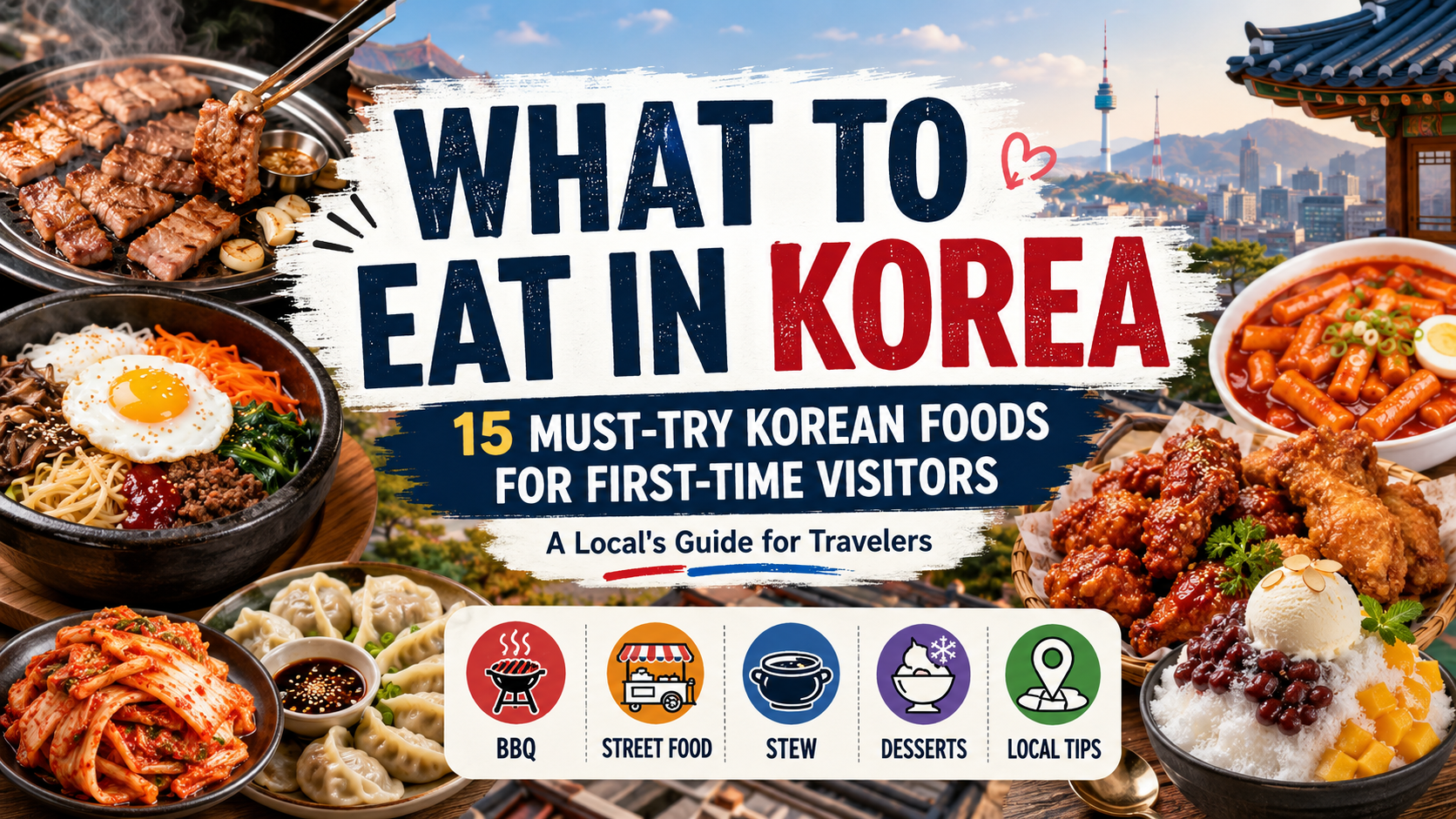
Korea is famous for its food, but on a first trip the hardest part can simply be deciding what to order.
If a friend were visiting me in Korea for the first time, I would not tell them to chase only the most famous restaurants. I would tell them to try a mix of foods: something grilled, something from a market, something Koreans eat at home, and at least one seasonal favorite.
So this list is not just a list of famous dishes. These are 15 foods and food experiences I would actually recommend to a first-time visitor, with the little things I would tell a friend before they eat them.

Quick Summary: 15 Korean Foods to Try

- Korean BBQ & Ssam — Grill thin cuts of meat and wrap them in lettuce with sauce and vegetables.
- Bibimbap — Rice mixed with vegetables, egg, meat and gochujang or soy-based seasoning.
- Tteokbokki — Chewy rice cakes in a spicy-sweet sauce, best with fish cake, fried snacks or sundae.
- Korean Fried Chicken — Crispy chicken with everything from plain fried to soy-garlic and spicy sauces.
- Samgyetang — Whole chicken simmered with rice, garlic, jujube and ginseng.
- Kimchi Jjigae & Doenjang Jjigae — Two everyday Korean stews built around fermented flavors.
- Ganjang Gejang — Raw crab marinated in soy sauce, famous for making you want another bowl of rice.
- Kimbap — Seaweed rice rolls that work perfectly as a quick meal or travel snack.
- Dakgalbi — Chicken cooked with a bold sauce, with spicy and milder versions depending on the restaurant.
- Dwaeji Gukbap — Pork soup with rice, especially associated with Busan.
- Jjajangmyeon — Noodles in black bean sauce; one of the easiest Korean comfort foods to try with kids.
- Dakhanmari — A whole chicken hot pot, usually finished with noodles.
- Galbijjim — Tender braised short ribs in a sweet-savory sauce.
- Summer Foods — Naengmyeon and bingsu are two of the best ways to eat through a Korean summer.
- Winter Street Food — Hotteok, bungeoppang and eomuk make cold-weather walking much more fun.
1. Korean BBQ & Ssam — The Meal I Would Start With
Korean BBQ is different from ordering a thick steak and waiting for the kitchen to cook it. The meat is often sliced thinner, grilled right at the table, and eaten as soon as it is ready.
That is one of the best parts. The cooking is fast, so you keep eating small pieces while they are hot and juicy instead of waiting for one large plate.
And then there is ssam.
Take a lettuce or perilla leaf, add a piece of grilled meat, a little ssamjang, garlic or another vegetable, wrap it up, and eat it in one bite. You get the crunch of the leaf first, then the warm meat and sauce together.

From My Experience: If you are traveling with kids, let them make their own ssam. Mine treat it almost like playing with toy food, carefully stacking everything inside the leaf. It usually turns dinner into part of the trip rather than just another meal.
If ordering or restaurant etiquette feels unfamiliar, see How to Order Food in Korea: A Simple Guide for Tourists.
2. Bibimbap — Korea in One Bowl
Bibimbap is rice mixed with several vegetables, often egg and meat, then seasoned with gochujang or another sauce.
Koreans eat many different namul, or seasoned vegetables, depending on the season. At home, bibimbap can feel like the practical Korean habit of bringing rice and several side dishes together in one big bowl and mixing everything.
If poke is familiar to you, the idea of a bowl built around rice and several toppings may feel easy to understand, although the flavors and preparation are very Korean.
It is also an easy way to try several vegetable textures in one meal. If you do not like spicy food, add the gochujang little by little or ask whether a milder seasoning is available.
3. Tteokbokki — Do Not Eat It Alone
Tteokbokki is one of Korea’s classic street foods: chewy rice cakes cooked in a red, spicy-sweet sauce.
But the rice cakes are only part of the experience. I personally love the fish cake in tteokbokki, and many Koreans order other foods to eat with the sauce.
Try adding ramen, glass noodles or udon when the restaurant offers extra noodles. Order fried snacks or sundae and dip them into the tteokbokki sauce.

Local Tip: This is one of the most Korean ways to enjoy tteokbokki. Also, do not trust the color alone. Some versions are seriously spicy. Ask about the spice level when possible, especially with children.
You may also see non-spicy or black-bean-sauce versions at some snack restaurants.
4. Korean Fried Chicken — Try the Simple Version and the Delivery Version
Korean fried chicken has become famous for its crisp texture and huge range of sauces.
You will see plain fried chicken, sweet-spicy yangnyeom, soy-garlic, cheese-seasoned styles and many brand-specific flavors.
One thing travelers with children should know is that even a chicken that looks plain can be seasoned more strongly than expected. Recipes vary by shop, so ask if you need something mild.
From My Experience: I would try a simple old-school market fried chicken once, then order a modern Korean chicken delivery to your accommodation on another night. Late-night chicken at the hotel is a very Korean travel memory in its own way.
5. Samgyetang — Korea’s Hot Summer Comfort Food
Samgyetang is a whole young chicken simmered with rice, garlic, jujube, ginseng and other ingredients.
It is a stamina food that Koreans famously eat during the hottest part of summer — the idea of fighting heat with heat.
The broth can feel richer than some visitors expect, but the rice and soft chicken make it easy to share with children if the restaurant’s seasoning works for your family.
After the chicken, the soft rice soaked in broth is one of my favorite parts.
6. Kimchi Jjigae & Doenjang Jjigae — Two Everyday Fermented Stews
If you want something closer to everyday Korean home food, try a jjigae.
Kimchi jjigae uses fermented kimchi and is usually spicy, sour and rich. Doenjang jjigae is built around fermented soybean paste and often includes tofu, vegetables and mushrooms.
These are true Korean comfort foods. You will see them at home-style restaurants and often alongside grilled meat.
Kimchi jjigae is usually too spicy for young children. Doenjang jjigae can be a better option, but spice levels still vary, so ask before ordering for kids.

7. Ganjang Gejang — The Famous ‘Rice Thief’
Ganjang gejang is raw crab marinated in a soy-based sauce.
Koreans call foods like this bap doduk, or ‘rice thief,’ because the salty, rich flavor makes you keep eating rice.
From My Experience: I like putting rice into the crab shell and mixing it with plenty of crab meat and sauce. Some people love sucking the meat from every leg; I usually focus on the body and shell.
If you really love it, you can even find restaurants that specialize in unlimited-refill gejang. Because it is raw shellfish, travelers with shellfish allergies or dietary restrictions should choose carefully.
8. Kimbap — Korea’s Everyday Grab-and-Go Food
Kimbap may look similar to a Japanese roll at first glance, but it is its own everyday Korean food.
The rice is usually seasoned with sesame oil and salt rather than prepared like sushi rice, and the fillings can include egg, vegetables, pickled radish, ham, tuna and many other combinations.
It is one of the easiest foods to buy before a train ride, picnic or busy sightseeing day.
Local Tip: Eat it fresh. Kimbap is made to be an easy same-day meal, not something I would leave sitting around for hours during a warm day.
9. Dakgalbi — Spicy Chicken Worth Sharing
Dakgalbi is chicken cooked with a bold sauce, often together with cabbage, sweet potato, rice cake and other ingredients.
Many travelers know Korea through very spicy instant noodles. Dakgalbi is a good chance to try a real Korean chicken dish with that spicy-sweet flavor family in a restaurant setting.
Depending on the restaurant, you may also find grilled versions or milder soy/salt-seasoned chicken that are easier with children.
I like eating chicken dishes like this with pickled radish because the cold, crisp bite cuts through the rich seasoning.
10. Dwaeji Gukbap — A Busan Soul Food
Dwaeji gukbap is pork soup with rice and is especially associated with Busan.
The pork aroma can be stronger at some traditional restaurants, which is part of the appeal for people who love the dish.
Eat it with kkakdugi, the crunchy cubed radish kimchi served on the side.
From My Experience: I have had periods when I ate gukbap almost every day. If you see both gukbap and ttaro gukbap, the difference may simply be whether the rice comes in the soup or separately. I prefer choosing based on how I feel that day.
11. Jjajangmyeon — Easy Comfort Food for Families
Jjajangmyeon is noodles covered in a thick black bean sauce, usually with pork and vegetables.
It is not spicy by default, which makes it one of the easiest Korean-Chinese dishes to try with children.
I actually prefer jjampong, the spicy seafood noodle soup, but when I eat jjajangmyeon I sometimes add chili powder for extra heat.
For a family, ordering jjajangmyeon for the kids and something spicier for the adults is an easy combination.
12. Dakhanmari — Chicken Hot Pot, Then Noodles
Dakhanmari literally means ‘one whole chicken.’ A chicken is simmered in a large pot at the table with vegetables and other ingredients.
The dipping sauce is part of the fun, and every regular seems to have a slightly different way of mixing it.
From My Experience: I like adding kimchi and seasoning to make the broth stronger, especially when I want something warming. Then I finish with kalguksu noodles. At that point, the meal turns into a bowl of rich chicken noodle soup.
Dongdaemun is especially famous for dakhanmari, and I will save my own dipping-sauce version for a future Dongdaemun guide.

13. Galbijjim — Save the Sauce for the Rice
Galbijjim is braised short ribs cooked until tender in a sweet-savory soy-based sauce.
It is rich, soft and usually much easier for spice-sensitive travelers than Korea’s red stews or spicy street foods.
Family Tip: When there is sauce left in the pot, I mix a little with rice for my kids. The sweet-savory sauce turns plain rice into something they usually finish very quickly.
14. Korean Summer Foods — Naengmyeon & Bingsu
Korean summer food deserves its own spot because the contrast is part of the experience.
Naengmyeon
Naengmyeon is served cold, either in chilled broth or mixed with a spicy sauce. Specialist restaurants are great, but one of my favorite times to eat naengmyeon is after Korean BBQ. Cold noodles after hot grilled meat just works.
Bingsu
For dessert, try bingsu. Modern snowflake-style bingsu often uses a soft milk base and is very easy to share with children. Traditional shaved-ice versions have a crunchier ice texture that I also like.
You may see luxury mango bingsu at major hotels, including famous hotel versions in Seoul. They can be expensive, but if one of those hotels is already part of your trip, it can be a fun splurge rather than something you need to chase across the city.

15. Korean Winter Street Food — Hotteok, Bungeoppang & Eomuk
This is the food that makes me look forward to winter.
Hotteok is a hot pancake usually filled with brown sugar, cinnamon or nuts. Bungeoppang is a fish-shaped pastry often filled with red bean or custard. Eomuk is fish cake served hot, often with a cup of warm broth.

There is not much technique to explain here.
From My Experience: Walk through a market or neighborhood on a cold day and eat one thing at a time. Hotteok here, bungeoppang a little later, then eomuk when you are cold again. Somehow a one-hour walk becomes a two-hour walk.
What If You Do Not Like Spicy Food?
Do not assume Korean food is all spicy.
Start with galbijjim, samgyetang, jjajangmyeon, kimbap, mild Korean BBQ, bibimbap with less gochujang, or a restaurant that can adjust the spice level.
For foods such as tteokbokki, kimchi jjigae and spicy dakgalbi, ask first. Some restaurants can adjust the heat, while others use a fixed sauce.
What I Would Tell a Friend Visiting Korea
Do not try to complete this list like a checklist.
Have Korean BBQ one night. Eat kimbap when you are moving between places. Try a soup or stew that Koreans actually eat as a normal meal. Stop at a market when you see something that looks good.
And pay attention to the season. Cold naengmyeon in summer and steaming eomuk in winter can be more memorable than eating the same famous dish everyone else photographed.
That is how I would want a friend to eat in Korea: not just collecting famous foods, but enjoying the way people here actually eat them.
FAQ
What Korean food should a first-time visitor try first?
Korean BBQ is a great first meal because the grilling, side dishes and ssam make it an experience as well as a meal. Bibimbap, kimbap and galbijjim are also approachable choices.
Is Korean food always spicy?
No. Many Korean dishes are mild or can be eaten with less spicy seasoning. Samgyetang, galbijjim, jjajangmyeon, kimbap and many BBQ dishes are good places to start.
What Korean food is good for children?
Jjajangmyeon, galbijjim, kimbap, mild Korean BBQ and samgyetang are often easier choices. Always check seasoning and spice level at the specific restaurant.
What should I eat at a Korean market?
Tteokbokki, fried snacks, eomuk, hotteok and seasonal street foods are easy foods to share while walking around a market.
What food should I try in Korea in summer or winter?
In summer, try naengmyeon and bingsu. In winter, look for hotteok, bungeoppang and hot eomuk at markets and street-food stalls.
Leave a Reply