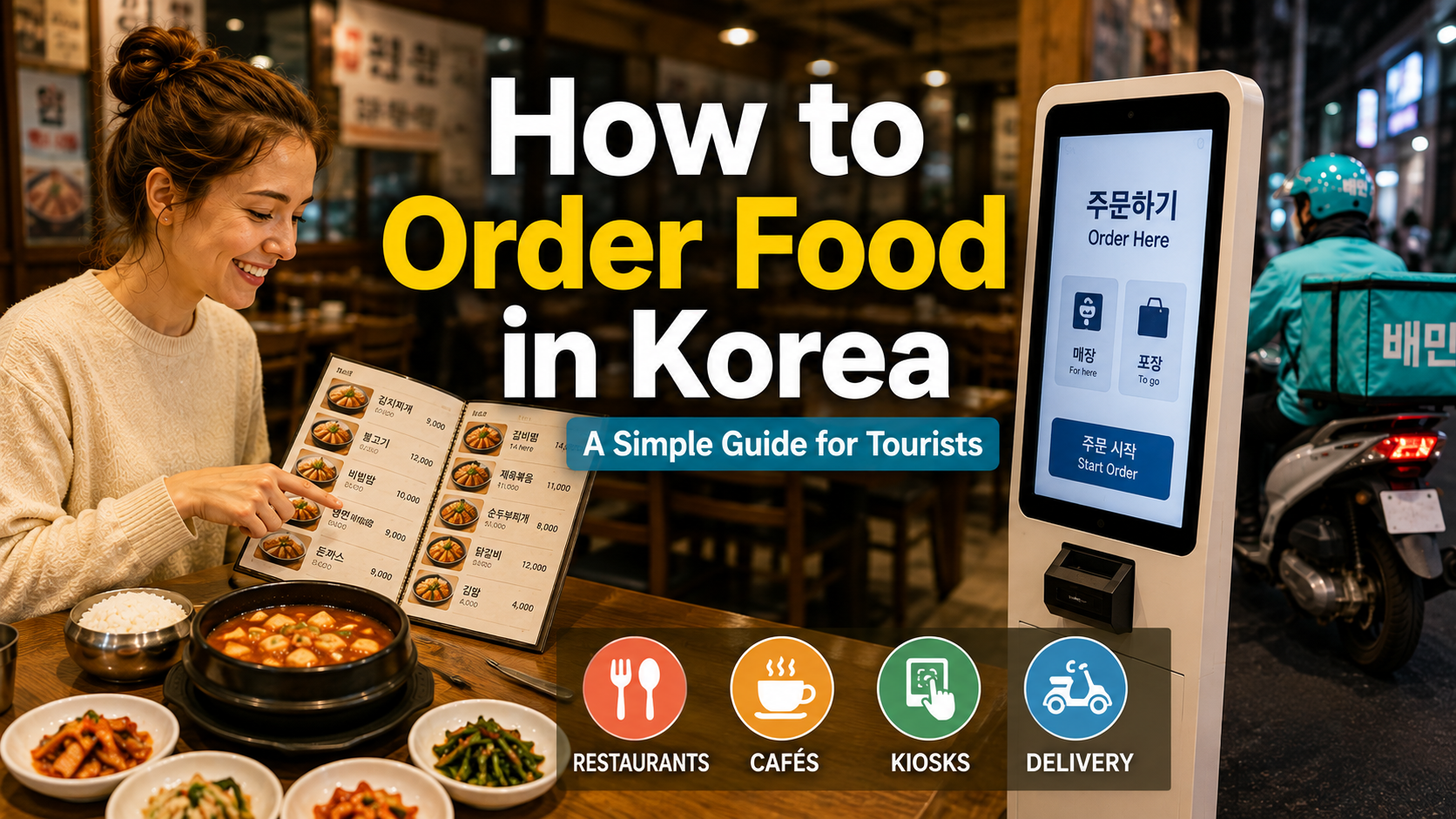
One of the most exciting moments of traveling abroad is sitting down at a restaurant and trying something delicious.
For me, it can also be one of the most intimidating moments.
A new environment, an unfamiliar language, and not knowing how to get a server’s attention or place an order can make it harder to enjoy the meal you were looking forward to.
That is why, if I were eating with a foreign friend visiting Korea, one of the first things I would want to explain carefully is how Korean restaurants actually work.
You do not need perfect Korean. What helps most is knowing the small signals: whether to call a server, press a bell, use a tablet or kiosk, check a self-service corner, or walk to the counter to pay.
Once you recognize those small signals, Korean restaurants start to feel much more predictable.

Quick Summary: Ordering Food in Korea
Here are the most important things to know before your first meal in Korea.
- Many restaurants let you order at the table, but kiosks and tablets are increasingly common.
- Some restaurants have self-service water, side dishes, or utensils.
- You usually pay at the counter when leaving, although some places require payment when ordering.
- Tipping is generally not expected.
- Translation apps can make Korean-only menus much easier.
- Food delivery can be more complicated for tourists, but foreigner-friendly services are available.
Once you know these basics, eating out in Korea becomes much easier.

1. Entering a Restaurant in Korea
When you enter a Korean restaurant, the first thing you may hear is:
“어서오세요!” (Eoseo oseyo!)
It simply means “Welcome!”
At many casual restaurants, a staff member will show you to a table.
If the restaurant is busy, you may need to wait near the entrance or add your name to a waiting list.
Some popular restaurants use digital waiting systems.
If you’re not sure what to do, simply hold up the number of fingers for your group and say:
“Two people, please.”
Or in Korean:
“두 명이요.” (Du myeong-iyo.) — Two people.
“세 명이요.” (Se myeong-iyo.) — Three people.
“네 명이요.” (Ne myeong-iyo.) — Four people.
Even if your Korean pronunciation isn’t perfect, restaurant staff will usually understand.
2. Understanding Korean Menus
Menus in tourist areas such as Myeongdong, Hongdae, Itaewon, and major attractions often include English.
However, smaller local restaurants may have menus only in Korean.
Don’t panic.
There are several easy ways to understand them.
Use a Translation App
Camera translation is extremely useful in Korea.
Simply point your phone at the menu and translate the text.
Papago and Google Translate are both useful options for travelers.
This works especially well for printed menus.
Look for Photos
Many Korean restaurants include photos of their most popular dishes.
If you see something you like, pointing at the photo and saying:
“이거 주세요.” (Igeo juseyo.)
means:
“This one, please.”
This is probably one of the most useful Korean phrases you can learn for your trip.
Check the Price Carefully
Prices on Korean menus are usually listed in Korean won (KRW).
For example:
₩10,000
₩15,000
₩25,000
One important thing to notice is whether the price is:
per person
or
per dish.
Korean barbecue restaurants, for example, may require a minimum order of two portions of meat.

3. How to Order at a Korean Restaurant
There are several different ordering systems in Korea.
Which one you use depends on the restaurant.
Ordering from a Server
At traditional restaurants, a staff member may come to your table.
But don’t be surprised if nobody comes immediately.
Many Korean restaurants have a small call button on the table.
Look for a button labeled:
호출
벨
Call
Pressing it calls a staff member.
Local Dad Tip: In Korea, pressing the call button is completely normal. You are not being rude or impatient. If I need another dish, extra rice, or help with the order, I usually press the button rather than waiting for someone to notice me.
Not every restaurant has a bell. At some small or busy local restaurants, Koreans may simply order as soon as they sit down, especially when they already know what they want.
If there is no bell and nobody comes over, raise your hand slightly and say “여기요” (yeogiyo). It is a very common way to get a server’s attention.
You may also hear Koreans call out “사장님” (sajangnim) in casual local restaurants, although “여기요” is the safer phrase for a visitor to remember.
Then you can simply point to the menu and say:
“이거 주세요.” — This one, please.
If you want two:
“이거 두 개 주세요.” — Two of these, please.
Ordering with a Tablet
Some restaurants have tablets installed at each table.
You select your food directly from the screen and send the order to the kitchen.
Some systems include English, Japanese, or Chinese language options.
Look for a globe icon or a language button before you start ordering.
Ordering at a Kiosk
Self-order kiosks are very common in Korea.
You’ll often find them at:
fast-food restaurants
cafés
food courts
casual restaurants
dessert shops
The basic process is usually:
- Select your language if available.
- Choose your food.
- Select options or extras.
- Choose dine-in or takeout.
- Pay.
- Take your receipt or order number.
- Wait for your number to appear on the screen.
If the kiosk doesn’t support English, using your phone’s camera translation can help.
From My Experience: Table-order systems and kiosks are common enough now that I would not treat them as unusual. For a traveler, they can actually make ordering easier when an English option is available because you can take your time checking photos, prices, extras, and quantities without feeling rushed.

4. Water, Side Dishes and Utensils
One thing that surprises many first-time visitors is that Korean restaurants often work differently from restaurants in other countries.
Free Side Dishes
Many Korean meals come with small side dishes called:
banchan (반찬)
Kimchi is the most famous example.
Depending on the restaurant, you may also receive vegetables, pickles, sauces, or other small dishes.
At many restaurants, additional servings of basic side dishes are available without an extra charge.
Some restaurants will bring refills to your table.
Others have a self-service area where you can get more yourself.
Water May Be Self-Service
If you don’t see water on the table, look around the restaurant.
You may see a sign saying:
셀프 (Self)
There may be a water dispenser, cups, and extra side dishes nearby.
Where Are the Chopsticks?
Sometimes you’ll sit down and wonder:
“Where are the chopsticks?”
Check the side or underneath the table.
Many Korean restaurant tables have a small drawer containing:
spoons
metal chopsticks
napkins
It’s a small detail, but knowing this can save you a lot of confusion.
From My Experience: When I sit down at a Korean restaurant, I often check the side of the table almost automatically. That is where spoons, metal chopsticks, napkins, or sometimes other small items may be stored.
If water or basic side dishes do not arrive, I usually look around for a self-service corner before calling staff.

Eating Out with Kids: What I Check First
When I eat out with my children, I think about more than just whether the food is spicy.
If possible, I ask for spicy sauce or seasoning to be removed or served separately before the dish arrives. I also ask whether the restaurant has children’s bowls, spoons, forks, or other kid-friendly tableware.
If I need to cut noodles, meat, pancakes, or another shared dish into smaller pieces, I will often ask for scissors.
One thing parents should pay attention to is heat. Korean food is often served very hot, and restaurants may have boiling soup, tabletop grills, hot stone bowls, or staff carrying hot dishes through narrow aisles.
If a high chair is available, I recommend using it. When choosing seats, I also try to keep my children away from the grill, hot dishes, and the main serving path.
Local Dad Tip: Self-service corners are convenient, but they can be awkward when you are alone with a small child. Get the child’s seat settled safely before you start walking back and forth for water, side dishes, or utensils.
5. Useful Korean Phrases for Ordering Food
You don’t need to speak Korean to enjoy restaurants in Korea.
But these phrases can make things easier.
“이거 주세요.”
Igeo juseyo.
This one, please.
“두 개 주세요.”
Du gae juseyo.
Two, please.
“물 주세요.”
Mul juseyo.
Water, please.
“안 매운 거 있어요?”
An maeun geo isseoyo?
Do you have something that isn’t spicy?
“계산할게요.”
Gyesanhalgeyo.
I’d like to pay.
“포장해 주세요.”
Pojanghae juseyo.
Please make it to go.
“감사합니다.”
Gamsahamnida.
Thank you.
“여기요.”
Yeogiyo.
Excuse me / Over here.
“앞치마 주세요.”
Apchima juseyo.
Please give me an apron.
“포장 가능해요?”
Pojang ganeunghaeyo?
Can I get this to go?
Don’t worry about perfect pronunciation.
A combination of simple Korean, pointing, and translation apps will handle most situations.
Ask for an Apron If You Are Worried About Splashes
Korean restaurants do not usually place a cloth bib or protective napkin at every seat.
But at restaurants where soup, noodles, barbecue sauce, or spicy food can easily splash onto your clothes, you can often ask for an apron.
Say “앞치마 주세요” (apchima juseyo) — “Please give me an apron.”
Depending on the restaurant, it may be a disposable apron or a reusable one.
6. Is Korean Food Always Spicy?
No.
Korean food has a reputation for being spicy, but there are plenty of mild dishes.
If you don’t like spicy food, try dishes such as:
bulgogi
galbitang
samgyetang
gimbap
japchae
seolleongtang
grilled fish
Korean barbecue
However, remember that even dishes that don’t look spicy may contain spicy seasoning.
If you’re sensitive to spicy food, ask:
“안 매운 거 있어요?”
“Do you have something that isn’t spicy?”
If you have serious food allergies, don’t rely only on visual inspection of the menu. Ingredients and sauces can contain items that aren’t obvious, so prepare a translated allergy message before visiting restaurants.
7. How to Pay at Restaurants in Korea
Payment in Korea is usually simple.
Credit and debit cards are widely used.
At many traditional restaurants, you don’t pay at the table.
Instead:
Finish your meal → walk to the cashier near the entrance → pay.
At cafés, kiosks, fast-food restaurants, and some modern restaurants, you’ll usually pay when ordering.
International cards often work, but carrying some Korean won is still useful in case a small shop, market stall, or payment terminal doesn’t accept your card.
Do You Tip in Korea?
Generally, no.
Tipping is not normally expected at Korean restaurants or cafés.
You simply pay the amount shown on the bill.
That makes dining out surprisingly straightforward once you get used to the system.

8. How to Order at a Café in Korea
Korea has an enormous café culture.
The ordering process is usually easy.
At the counter, choose:
your drink
size
hot or iced
any additional options
Then pay and receive either:
an order number
a receipt
or a vibrating pager.
When your drink is ready, pick it up at the collection counter.
At some cafés, you’ll order using a kiosk instead.
One useful thing to know:
If you want an iced Americano, you can simply say:
“아이스 아메리카노 주세요.”
You’ll hear Koreans call it “아아” (Ah-Ah), short for iced Americano.
9. Takeout in Korea
Want to take your food with you?
Say:
“포장해 주세요.”
(Pojanghae juseyo.)
It means:
“Please make it to go.”
At kiosks, you’ll usually see two options:
Dine In
Take Out
Takeout is extremely common in Korea, especially at cafés, bakeries, fast-food restaurants, and snack shops.
10. Ordering Food Delivery in Korea
Korea has a huge food-delivery culture, and ordering delivery can be a fun part of the trip.
The apps Koreans commonly use include Baemin (Baedal Minjok), Coupang Eats, and Yogiyo. Access for international visitors has improved, but the experience can still depend on your phone number, payment method, language settings, and whether you order as a guest or registered user.
For a short-term visitor, I would not assume that every Korean delivery app will work perfectly with every foreign phone number or card.
The Most Foreigner-Focused Option
Shuttle Delivery is designed for international users and is currently presented by Korea Tourism Organization as an option for foreign visitors. It supports international cards and is designed to work without Korean phone-number verification.
What About Baemin, Coupang Eats, and Yogiyo?
These are major delivery apps used in Korea, and access for foreign visitors has been improving.
Some international travelers report successfully ordering with foreign phone numbers, guest ordering, foreign cards, or mobile-wallet options, while others still run into registration, verification, or payment problems depending on their country, phone number, and app setup.
So I would treat these apps as worth trying rather than guaranteed.
Hotel Delivery
If you are staying at a hotel, check whether outside food delivery is allowed and where the driver should meet you.
In many cases, the lobby is the easiest meeting point. Copying the hotel’s Korean address from Naver Map or your booking confirmation can also make delivery smoother.
Fallback Tip: If delivery apps are giving you trouble, takeaway is much easier. Ask “포장 가능해요?” (pojang ganeunghaeyo?) — “Can I get this to go?”

11. Common Mistakes First-Time Visitors Make
Here are a few mistakes that are easy to avoid.
Waiting forever for a server when there’s a call button on the table.
Waiting quietly even when there is no call button. If you need help, raising your hand and saying “여기요” is completely normal.
Not checking whether water and side dishes are self-service.
Assuming every menu will have English.
Forgetting to check whether barbecue prices are per serving.
Trying to tip when it isn’t expected.
Leaving the restaurant without paying because you expected the bill to come to your table.
And one of the biggest mistakes:
Being too nervous to enter a local restaurant.
Even if you don’t speak Korean, a smartphone, a few basic phrases, and pointing at the menu will get you surprisingly far.
12. A Simple Restaurant Routine to Remember
If this is your first trip to Korea, remember this simple routine:
Enter the restaurant.
Wait to be seated or choose a seat.
Check the menu.
Use camera translation if necessary.
Order from the server, tablet, or kiosk.
If nobody comes and there is no call button, raise your hand and say “여기요.”
If you are with children, settle them safely before using a self-service corner or handling hot shared dishes.
Check whether water and side dishes are self-service.
Enjoy your meal.
Walk to the counter to pay unless you already paid when ordering.
That’s it.
After doing this once or twice, Korean restaurants will feel completely normal.
Final Tips
Food is one of the best parts of traveling in Korea.
Don’t limit yourself only to restaurants with large English signs.
Some of your favorite meals may come from small neighborhood restaurants where the menu is mostly Korean.
Keep your phone ready for translation, learn “이거 주세요” (This one, please), and don’t be afraid to ask for help.
The small routines become familiar quickly. By the time you know where to look for the call bell, self-service corner, table drawer, apron, and cashier, the restaurant stops feeling unfamiliar.
Most importantly, enjoy trying something new.
Your first Korean restaurant might feel confusing for five minutes.
By your third meal, you’ll probably be ordering like you’ve done it before.
Related Guides
Planning your first trip to Korea? These guides will make your trip much easier:
What to Eat in Korea: Must-Try Korean Foods for First-Time Visitors
Best Apps for Korea Travel: Maps, Translation, Transportation & More
Internet in Korea: eSIM, SIM Card & Pocket WiFi Guide
Incheon Airport to Seoul: Best Transportation Options
20 Essential Korea Travel Tips for First-Time Visitors
Read these guides before your trip and you’ll be ready for everything from getting online at the airport to ordering your first Korean meal.
Leave a Reply